

Understand Your Personality Better in Projects
Discover how a Process Communication Model (PCM) analysis can help you gain a clearer understanding of your personality, improve communication, and deal more effectively with stress and motivation – specifically in your role as a project manager, leader, or team member.
What is PCM? – A Brief Overview
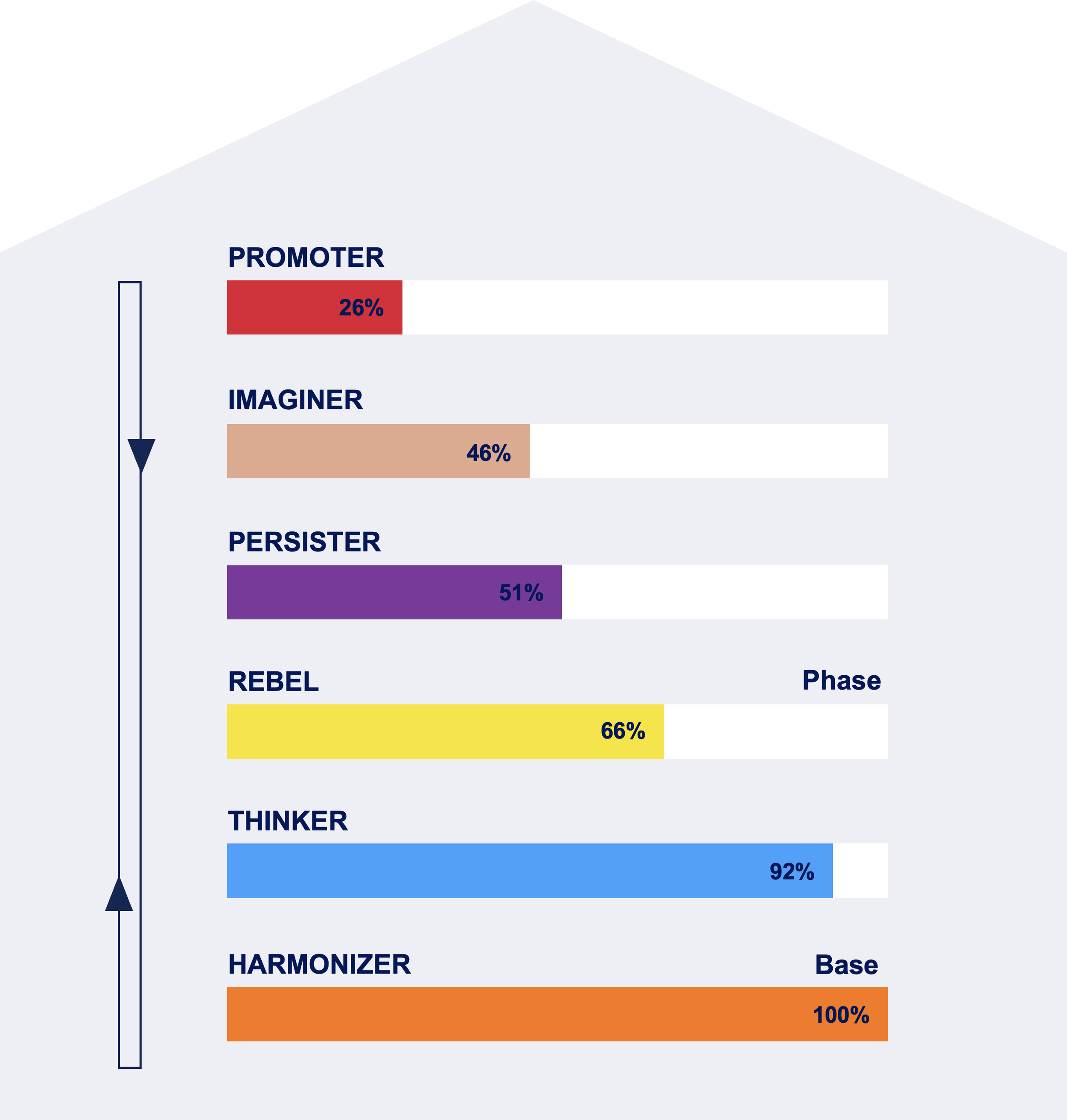
PCM (Process Communication Model) is a research-based psychological model designed to help you better understand yourself and others. Developed by Dr Taibi Kahler, PCM combines a personality model with a communication model and explains how people communicate with one another – and why misunderstandings can arise.
PCM distinguishes between six Personality Types:
Imaginer
Promoter
Rebel
Harmonizer
Persister
Thinker
Everyone has all six Personality Types within them, but in different proportions. This unique Personality Structure has a significant influence on how we communicate. Process Communication Model
PCM gives you concrete insights into:
Your typical communication patterns
Your preferred way of perceiving information
Your Character Strengths and potential
Your Psychological Needs
Your Drivers and distress patterns
How We Perceive the World
We all perceive the world through six different Perceptions:
Thoughts
Opinions
Feelings
Reactions
Reflections
Actions
All six Perceptions are available to us. How we perceive the world – other people, new situations, and so on – is reflected in the language and vocabulary we use.
The Perception and vocabulary we use most often – comparable to our native language – is that of our strongest Personality Type, our Base. The other “languages” are available to us as well, depending on how strongly the respective Personality Types are represented in our Personality Structure.
Psychological Needs, Drivers and Distress Patterns
Each Personality Type is associated with specific Psychological Needs, and meeting these needs is essential for motivation and satisfaction. When these needs are not met or are negatively affected, characteristic distress patterns can emerge and become clearly visible in our behaviour. These patterns differ depending on the Personality Type and can be recognised and addressed using PCM.
By understanding your own Psychological Needs, Drivers and distress patterns, you can better understand yourself and your behaviour and respond to them more consciously and proactively. At the same time, you learn to recognise the needs and distress signals of others, enabling more effective and empathic communication.
Who Is a PCM Analysis For?
PCM is particularly valuable for people in positions of responsibility who are willing to take responsibility for themselves and others and who want to continuously develop, such as:
Project managers and team leaders
Leaders in line (functional) and project roles
People going through periods of change and looking for greater clarity
Typical challenges where PCM can help include:
Building relationships and trust more quickly within project teams
Motivating project team members with different levels of engagement
Communicating more effectively with sponsors and stakeholders
Dealing with your own and others’ distress patterns and frustrations

Your Personal Benefits from a PCM Analysis
By gaining a clearer understanding of your PCM Personality Structure, you can specifically and effectively:
Recognise and improve your own communication patterns
Clearly identify your Psychological Needs and meet them more deliberately
Recognise distress patterns early and respond to them proactively
Reduce misunderstandings and conflicts while strengthening relationships over the long term
Identify your personal sources and drains of energy
Shape your leadership behaviour more consciously, reflectively and purposefully
As a result, you can act with greater confidence, clarity and effectiveness.
How Does a PCM Analysis Work?
-
Takes approximately 25–45 minutes
Can be completed conveniently from home
-
Takes approximately 60 minutes
Discussion of your results:
Personality Structure
Perceptions and Interaction Styles
Character Strengths and preferred Environment
Your most important Psychological Needs
-
Approx. 25 pages, including recommendations and reflections
Total duration: approx. 2 to 2.5 hours (questionnaire + debriefing)
Format: Usually online
PCM & Spectrum of Needs Profile
You can create your Spectrum of Needs needs profile easily using an online tool that assesses your needs based on the Spectrum of Needs model. You rate the strength of your needs on a scale from 1 to 5. As a result, you receive a clear graphical needs profile showing how strongly each of your needs is expressed. In addition, your results are broadly assigned to one of three needs areas (Self, Us, System). This is not intended as a rigid typology, but rather as an initial orientation that helps you classify your needs more clearly and give them greater personal meaning.
You can also copy the collected data to your clipboard and analyse it further using AI tools such as ChatGPT, Google Gemini, or Microsoft Copilot.
The PCM analysis, by contrast, provides you with a detailed Personality Profile showing the individual configuration of the six PCM Personality Types within your Personality Structure. Everyone has all six Personality Types within them, but their relative strength and accessibility differ from person to person. Each Personality Type is associated with specific Character Strengths, characteristics, and Psychological Needs. Under distress, characteristic behavioural patterns can emerge depending on the Personality Type, which PCM helps you recognise and manage more effectively.
Together, the Spectrum of Needs needs profile and the PCM analysis provide a valuable combination: the needs profile offers a simple and clear starting point for understanding your fundamental needs and gaining initial insights into motivation and conflict behaviour. The PCM analysis complements this with a more differentiated and in-depth view of your Personality Structure. This gives you a more comprehensive understanding of your own behaviour and allows you to use these insights purposefully for your personal development.
Turning Insights into Practice
A PCM analysis can provide valuable insights into your personality, your needs, communication patterns, and your behaviour under stress. What matters, however, is how you use these insights in your everyday life.
If you would like to explore these insights further and apply them to specific professional or personal questions, you can work individually with Daniel Hendling, MBA. He combines his experience in project management, leadership, and personal development with a consistently needs-focused perspective on people and collaboration.
The focus is on your specific situation: for example, leadership and collaboration, motivation and needs, communication, conflict, personal development, or current challenges in projects and change processes.
Your PCM Profile can serve as an additional basis for reflection and development – alongside the Spectrum of Needs profile and other insights about yourself.
The creation and professional debriefing of your PCM Profile are provided by a certified PCM Coach. In the subsequent work with Daniel, the insights gained from it can be deliberately taken up and connected with your specific topics, goals, and challenges. PCM is one possible perspective among several – embedded in a broader, needs-focused approach.